C.S. Lewis, the Quadrivium, and Re-Enchanting the Mind
Embrace the Fullness of the Liberal Arts
These remarks were given at the 2026 New Aberdeen College Convocation ceremony.
Thank you, Dr. Smith, for your remarks and kind introduction. What you are building here is needed, and it is being built to the glory of God. I’m grateful to play a small part in beginning the second year of New Aberdeen College.
When Dr. Smith called me some months ago, he asked if I could address the quadrivium and C.S. Lewis in my remarks this evening. I’ve been rolling those themes around, and I think I’ve landed on helpful connection points. The Trivium gets lots of love in the classical education world, but we’re much less sure what to do about the Quadrivium. Most teachers in classical education could sit and seminar about great books all day; but hand them a riddle from Euler? A sextant, and ask them to navigate from A to B? To explain the relationship between astronomy, mathematics, geometry, and the soul? Suddenly, the rhetoric about educating the whole person and embracing all the liberal arts rings slightly hollow. My friend Phillip Johnson is the Quadrivium professor at New College Franklin; he’s an academic unicorn who combines a deep love of philosophy with a PhD in engineering. Not many combine these areas.
But tonight, I want to direct our attention to the Quadrivium, and see what C.S. Lewis can show us about just why the Quadrivium is vital if we’re serious about recovering humanity in a modernist age.
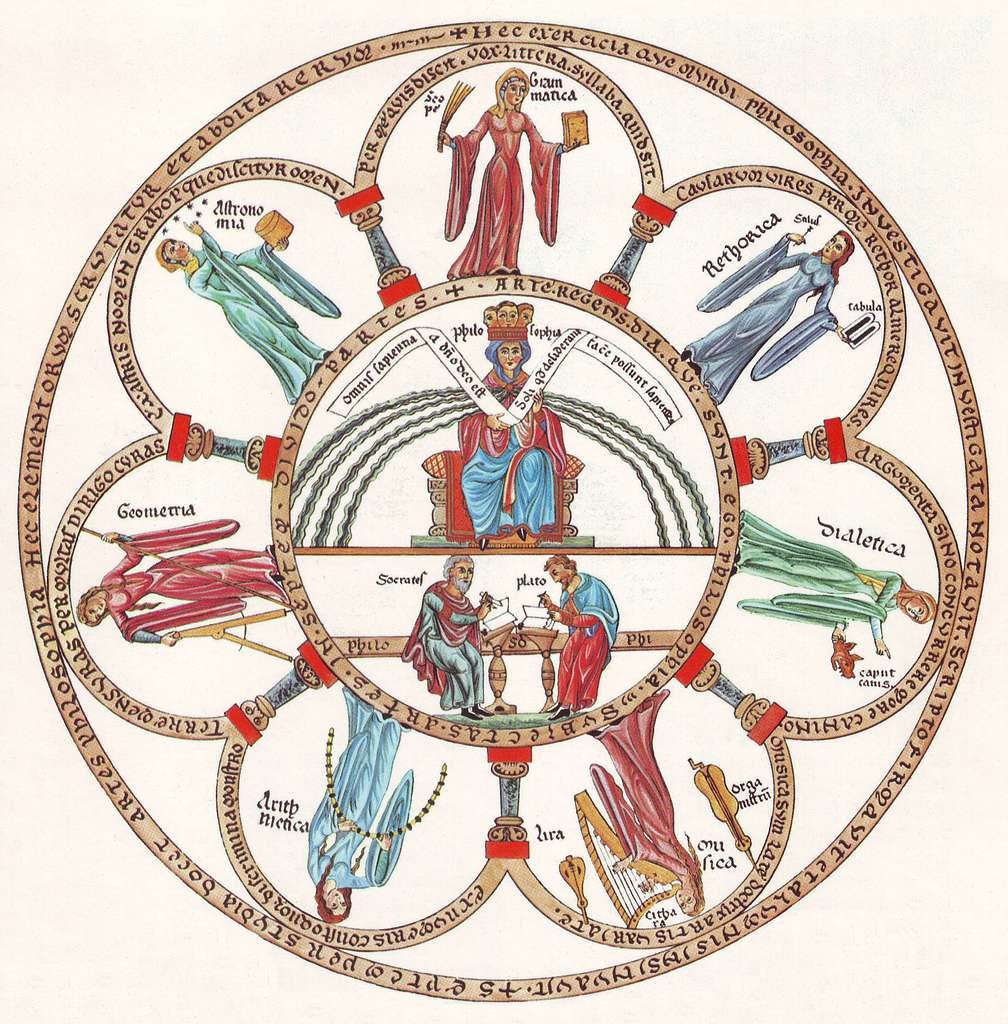
Permit me a moment to define my terms. In an audience of this size, it’s likely we have those very familiar with the liberal arts, and those new to this tradition. The artes liberales are the arts which set men free from ignorance and servitude; the ancient Greeks taught that these were the right education of a free man. Medieval Christendom baptized this tradition, and codified it into seven specific arts: the Trivium, the “three ways,” is comprised of Grammar, Logic and Rhetoric. These language arts encompass literature and language, the laws of thought, and the full study of persuasion. The Quadrivium moves into what today we would call the quantifiable arts of mathematics, geometry, music, and astronomy. Until the advent of modernity, these seven arts were the essential core of western education; to be an educated human being meant to be versed in these arts. A remnant of that position remains in the names of degrees – a bachelor of arts, a master of arts – both were rungs on the ladder of degree marking proficiency in the liberal arts.
One further term needs definition – I’ve been using modern, modernism, modernity interchangeably, and mostly with negative connotation. By “modern” I mean the era of thought and culture inaugurated by the French Revolution in 1789; the Revolution was the child of Enlightenment skepticism, and has produced now 237 years of ongoing strife between a mainstream western world convinced materialism is sufficient to explain reality, and everyone who perceives a higher, spiritual level of reality. Classical education, in both its K-12 form and its collegiate form, stands opposed to modernity in this sense; we are part of a multi-generational effort to recover the fullness of reality and transmit to the next generation a conviction that humans must live in alignment with the real.
C.S. Lewis was another opponent of modernity. One of the clearest places to see his opposition is in his 1954 inaugural lecture at Cambridge University. He closed that lecture this way:
It is my settled conviction that in order to read Old Western literature aright you must suspend most of the responses and unlearn most of the habits you have acquired in reading modern literature. And because this is the judgement of a native, I claim that, even if the defence of my conviction is weak, the fact of my conviction is a historical datum to which you should give full weight. That way, where I fail as a critic, I may yet be useful as a specimen. Speaking not only for myself but for all other Old Western men whom you may meet, I would say, use your specimens while you can. There are not going to be many more dinosaurs.1
Lewis introduced himself to Cambridge as a dinosaur, a native of Old Western literature. He claimed the position of being able to judge modernity, because he was steeped in the wisdom and perspectives of the great tradition. In short, Lewis was right. He functions today as a channel of the great tradition.
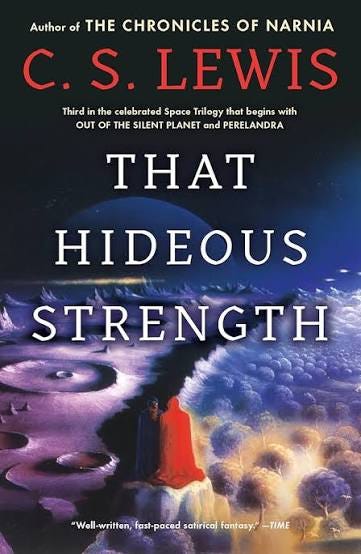
In the 1930s and 1940s, he saw where the Western world was going; his gift of logical deduction, paired with deep training in humanist scholarship, enabled him to write the most prophetic books. If you have not read The Abolition of Man or That Hideous Strength, I offer this challenge. The next time you see a shocking headline, pick one of those to work through. I suspect you’ll find that Lewis predicted either the exact headline, or the genre of event being reported.
With those definitions in mind, let us turn to consider the sad fate of Urania, Muse of Astronomy, in the modern day. I want to tell you a familiar story, in perhaps unfamiliar language.
Once upon a time, man was the center of the cosmos. He held a divine glory as the pinnacle of earthly creation, with his home the physical center of the cosmos. Around man, the stars were fixed and the planetes, the wanderers, moved across the night sky. The ancients believed that the stars and the planets determined fate; Christianity did not reject that view, but softened it, permitting the belief that the stars and the planets shed influence on creation. The heavenly bodies were agents of God’s active rule and reign over creation; through their influence, all human behavior could be explained. Why are some men fortunate, and others never catch a break? Why are some filled with passions of rage, lust, and envy, while others are marked by a profound passivity? The differing influences of Venus, Mars, Mercury, and Jove explained human behavior.
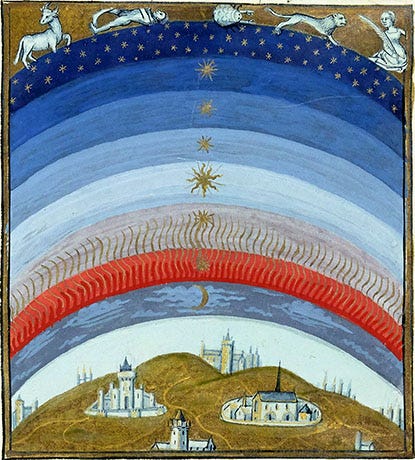
Bibliothèque nationale de France, département des Manuscrits; Mss.fr.143, fo 20.
The problem with this story is that it is not factually true. And this is where the familiar elements of astronomy’s fate come in. Across the 16th-17th centuries, a revolution in thought occurred. It involves familiar names: Galileo, Kepler, Tycho Brahe, and Copernicus. By the 18th century, the consensus of thought had shifted: the sun was at the center. Earth, humanity’s home, was no longer at the center. The plausibility of physical objects having spiritual, psychological effect was mocked by the intellectual class. The stars shifted in the modern imaginary from objects of wonder to “big balls of gas burning billions of miles away.”
And public instruction in astronomy faded. The old stories about the stars, with all their links to Greek mythology—Cassiopeia, the Twins, Cygnus, and so on—shifted from general knowledge that everyone once knew to curios that impressed at parties.
Astronomy was once seen as one of the highest forms of knowledge, just below philosophy and theology. It was the pinnacle of an intellectual ascent from the study of ordered language, to ordered number, shape, and sound, to now an ordered cosmos. But in an age that rejects the very idea of an ordered reality (because that implies an Orderer, a Creator), astronomy finds little purchase in the curriculum.
And that brings us to C.S. Lewis. In his final (and less often read) book The Discarded Image, submitted for publication in 1963, the year of his death, but released in 1964, Lewis codified the lectures from his Introduction to Medieval and Renaissance Literature course. There is much we could discuss from this book, but I will confine myself to the role Lewis thought an appreciation of the older view of astronomy could play. Such an appreciation checks our confidence in what science can claim.
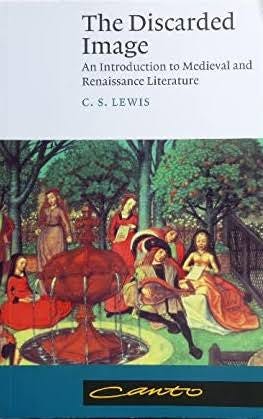
He admits that on a physical level, the new cosmology is mathematically correct. But on an imaginative level, the older view expressed truths about human nature that we ought not let escape. In his fiction, Lewis aspires to re-enchant our imaginations to see the fullness of God’s creation; in his stories, in both The Chronicles of Narnia and The Ransom Trilogy, Lewis includes the old view of astronomy. And by attuning ourselves to that side of Lewis, we can push back against the materialism of our day.
I want to read one lengthy passage from The Discarded Image. This is from chapter 5, “The Heavens.”
These facts are in themselves curiosities of mediocre interest. They become valuable only in so far as they enable us to enter more fully into the consciousness of our ancestors by realising how such a universe must have affected those who believed in it. The recipe for such realisation is not the study of books. You must go out on a starry night and walk about for half an hour trying to see the sky in terms of the old cosmology. Remember that you now have an absolute Up and Down. The Earth is really the centre, really the lowest place; movement to it from whatever direction is downward movement. As a modern, you located the stars at a great distance. For distance you must now substitute that very special, and far less abstract, sort of distance which we call height; height which speaks immediately to our muscles and nerves. The Medieval Model is vertiginous. And the fact that the height of the stars in medieval astronomy is very small compared with their distance in the modern, will not turn out to have the kind of importance you anticipated. For thought and imagination, ten million miles and a thousand million miles are much the same. Both can be conceived (that is, we do sums with both) and neither can be imagined; and the more imagination we have the better we shall know this. The really important difference is that the medieval universe, while unimaginably large, was also unambiguously finite…To look up at the towering medieval universe is much more like looking at a great building. The ‘space’ of modern astronomy may arouse terror, or bewilderment or vague reverie; the spheres of the old present us with an object in which the mind can rest, overwhelming in its greatness but satisfying in its harmony.2
For Lewis, the old medieval model was a human-shaped vision of the cosmos, one harmonious to the mind. Rather than a modern egalitarian flatness operating on a horizontal plane, the older model was a vertical hierarchy. The old model is best conceived imagining lying on your back looking upward at the sky – the moon, Venus, Mars, Jupiter and the rest are concentric rings above you. Lewis thinks it is no accident that the deeply hierarchical medieval world imagined the cosmos to fit the notion of hierarchy; similarly, it is not an accident that our democratic age imagines the cosmos flattened to horizontal equality.
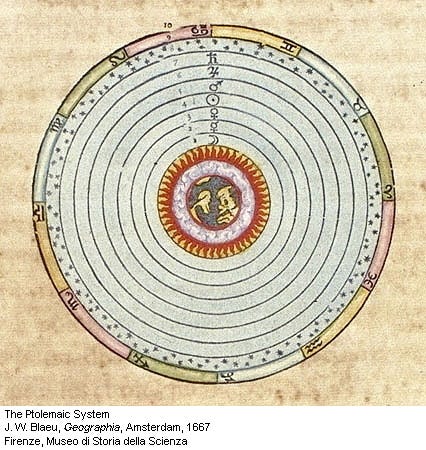
The model of the universe reflects our cultural imaginary about who we are as human beings and what cosmos we inhabit. And here we begin seeing just why we need the Quadrivium—we need math, geometry, music, and astronomy to help perceive the fullness of creation. And we also begin to see why Lewis is so helpful. The modern imaginary presents a vision of the cosmos where man is but an insignificant speck in an infinite expanse. To press against such a myth, we need both a critique of that myth and a replacement.
By the end of The Discarded Image, Lewis addresses skeptics who question why anyone would consider a disproven model of the universe. He writes,
I have made no serious effort to hide the fact that the old Model delights me as I believe it delighted our ancestors. Few constructions of the imagination seem to me to have combined splendour, sobriety, and coherence in the same degree. It is possible that some readers have long been itching to remind me that it had one serious defect; it was not true.
I agree. It was not true. But I would like to end by saying that this charge can no longer have exactly the same sort of weight for us that it would have had in the nineteenth century. …The mathematics are now the nearest to the reality we can get. Anything imaginable, even anything that can be manipulated by ordinary (that is, non-mathematical) conceptions, far from being a further truth to which mathematics were the avenue, is a mere analogy, a concession to our weakness. Without a parable modern physics speaks not to the multitudes.
…
I am only suggesting considerations that may induce us to regard all Models in the right way, respecting each and idolising none. We are all, very properly, familiar with the idea that in every age the human mind is deeply influenced by the accepted Model of the universe. But there is a two-way traffic; the Model is also influenced by the prevailing temper of mind…No model is a catalogue of ultimate realities, and none is a mere fantasy. Each is a serious attempt to get in all the phenomena known at a given period, and each succeeds in getting in a great many. But also, no less surely, each reflects the prevalent psychology of an age almost as much as it reflects the state of that age’s knowledge. Hardly any battery of new facts could have persuaded a Greek that the universe had an attribute so repugnant to him as infinity; hardly any such battery could persuade a modern that it is hierarchical.3
Lewis was deeply attuned to the way the older mode of thought differed from the modern. Part of the danger he saw in modern science is the pretense of objectivity it claims. It’s one thing for a myth maker to tell explanatory stories about reality; to claim the objectivity of fact is another thing entirely.
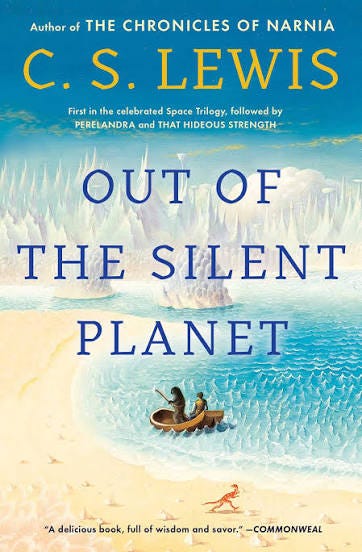
In the Ransom Trilogy, Lewis self-consciously opposes modern science and a mythic awakening to reality. He introduces this theme in Out of the Silent Planet, and develops it further in both Perelandraand That Hideous Strength. For time’s sake, I’ll share just one passage from Out of the Silent Planet. Protagonist Elwin Ransom has been kidnapped by two scientists and is enroute from Earth to Mars. On his interplanetary travels, Ransom experiences what we would call “Outer Space” very differently than he expected.
Stretched naked on his bed, a second Danae, [Ransom] found it night by night more difficult to disbelieve in old astrology: almost he felt, wholly he imagined, ‘sweet influence’ pouring or even stabbing into his surrendered body…
A nightmare, long engendered in the modern mind by the mythology that follows in the wake of science, was falling off him. He had read of ‘Space’: at the back of his thinking for years had lurked the dismal fancy of the black, cold vacuity, the utter deadness, which was supposed to separate the worlds. He had not known how much it affected him till now—now that the very name ‘Space’ seemed a blasphemous libel for this empyrean ocean of radiance in which they swam. He could not call it ‘dead’; he felt life pouring into him from it every moment. How indeed should it be otherwise, since out of this ocean the worlds and all their life had come? He had thought it barren: he saw that it was the womb of worlds, whose blazing and innumerable offspring looked down nightly even upon the earth with so many eyes—and here, with how many more! No: space was the wrong name. Older thinkers had been wiser when they named it simply the heavens—the heavens which declared the glory—the
‘happy climes that ly
Where day never shuts his eye
Up in the broad fields of the sky.’
He quoted Milton’s words to himself lovingly, at this time and often.4
“Space” as a term, Lewis contends, carries with it a mythology of death, emptiness, void. Humans cannot live in “space.” The “heavens” thrum with life; the heavens are a place people perhaps can go. In using the term “space,” modern cosmology claims objectivity while actually communicating a meaningful myth.
Science pretends to objectivity while proclaiming an explanatory myth of reality; modernity is built upon the twin mythological supports of progressivism and biological evolution; these two give rise to a vision of an infinitely expanding universe in which humans are insignificant. Lewis calls this “a new archetypal image. It is the image of old machines being superseded by new and better ones. For in the world of machines the new most often really is better and the primitive really is the clumsy. And this image, potent in all our minds, reigns almost without rival in the minds of the uneducated.”5 Continual progression and infinite growth is the myth of modernity. Rather than achieving a true objectivity, modern science is built upon a particular myth. Lewis’s project involves first identifying that myth, and proposing a different, Creator-centric mythic foundation.
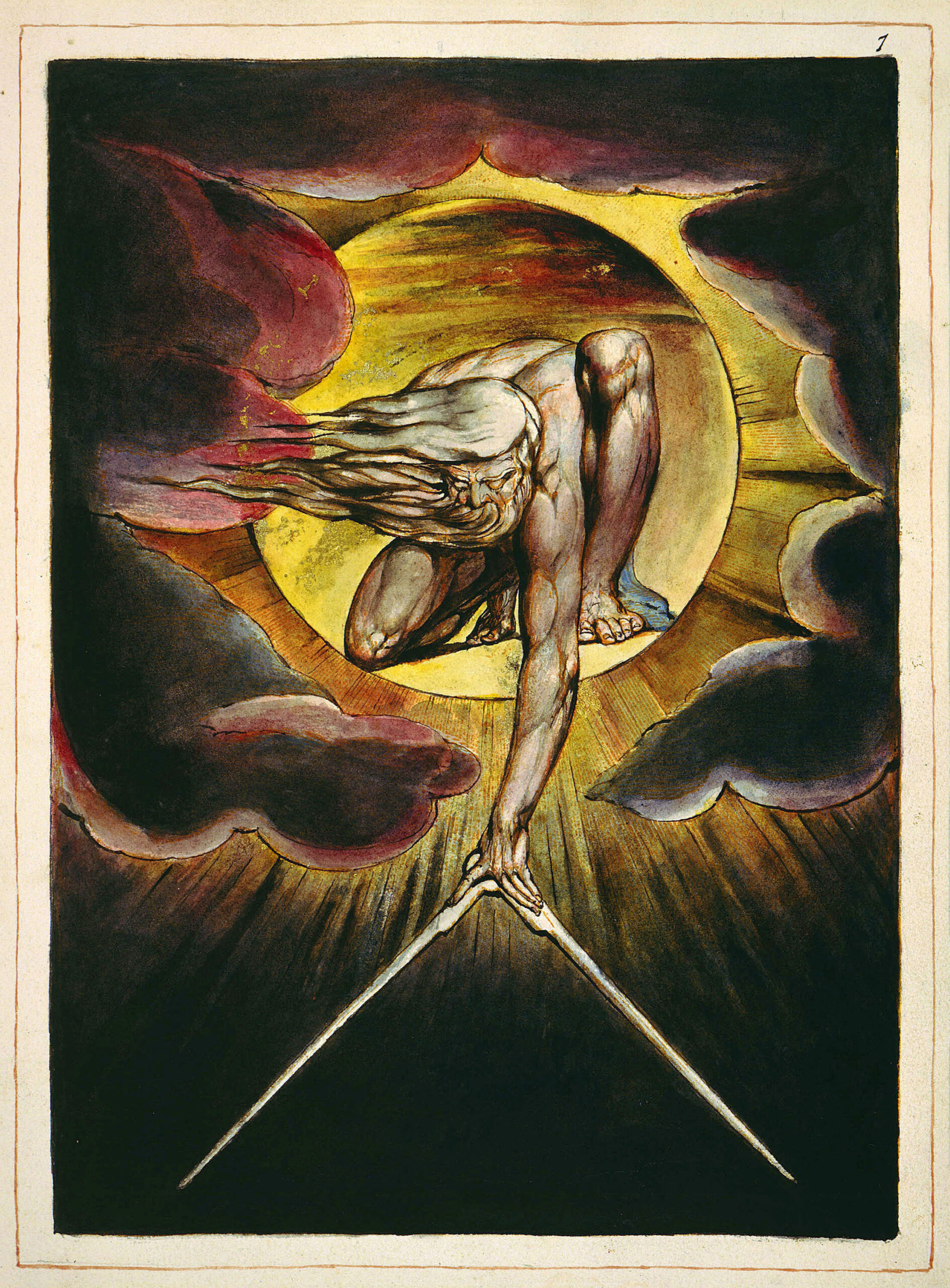
Throughout his writings, Lewis is up to a larger project than telling a single story: he wants to re-enchant our imaginations to perceive the wonder and the glory of creation as the complex, beautiful, coherent work of the loving Creator. Our task is to receive the gift of reality, and spend both our lifetimes and an eternity-forward unfolding this beautiful gift. The gift is not merely one of the Trivium; God is the great storyteller, but He is also the marvelous Architect. He is the origin of mathematical precision, geometrical vision, musical complexity, and astronomical wonder. Lewis tells wonderful stories; he himself is a master of the arts of the Trivium. But part of his value for us lies in his refusal to ignore physics, math, and astronomy in his stories. To re-enchant the mind, all of the mind must comprehend the beauty of God’s creation. And for that, we need the Quadrivium. We need to recover astronomy and story both; we need the fullness of the liberal arts.
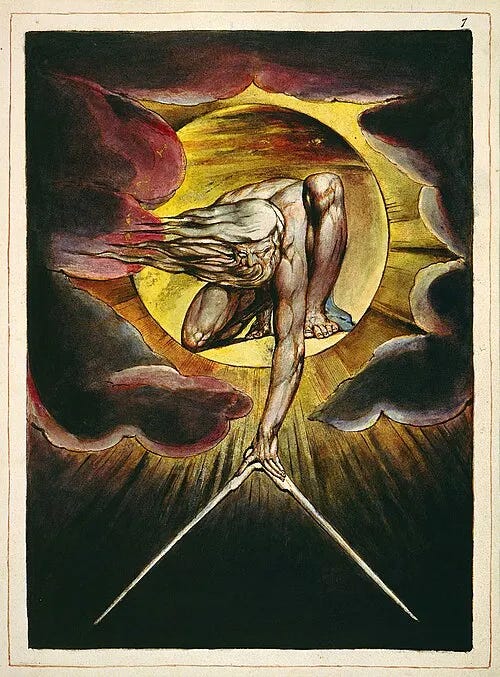
The Ancient of Days setting a Compass to the Earth, frontispiece to copy K of Europe a Prophecy
1 C.S. Lewis, “De Descriptione Temporum” (Cambridge, 1954).
2 C.S. Lewis. The Discarded Image: An Introduction to Medieval and Renaissance Literature (Cambridge: Cambridge University Press, 2010), 98-99.
3 Lewis. The Discarded Image, 216-222.
4 C.S. Lewis. Out of the Silent Planet (New York: Scribner, 2003), 33-34.
5 C.S. Lewis, “De Descriptione Temporum” (Cambridge, 1954).