
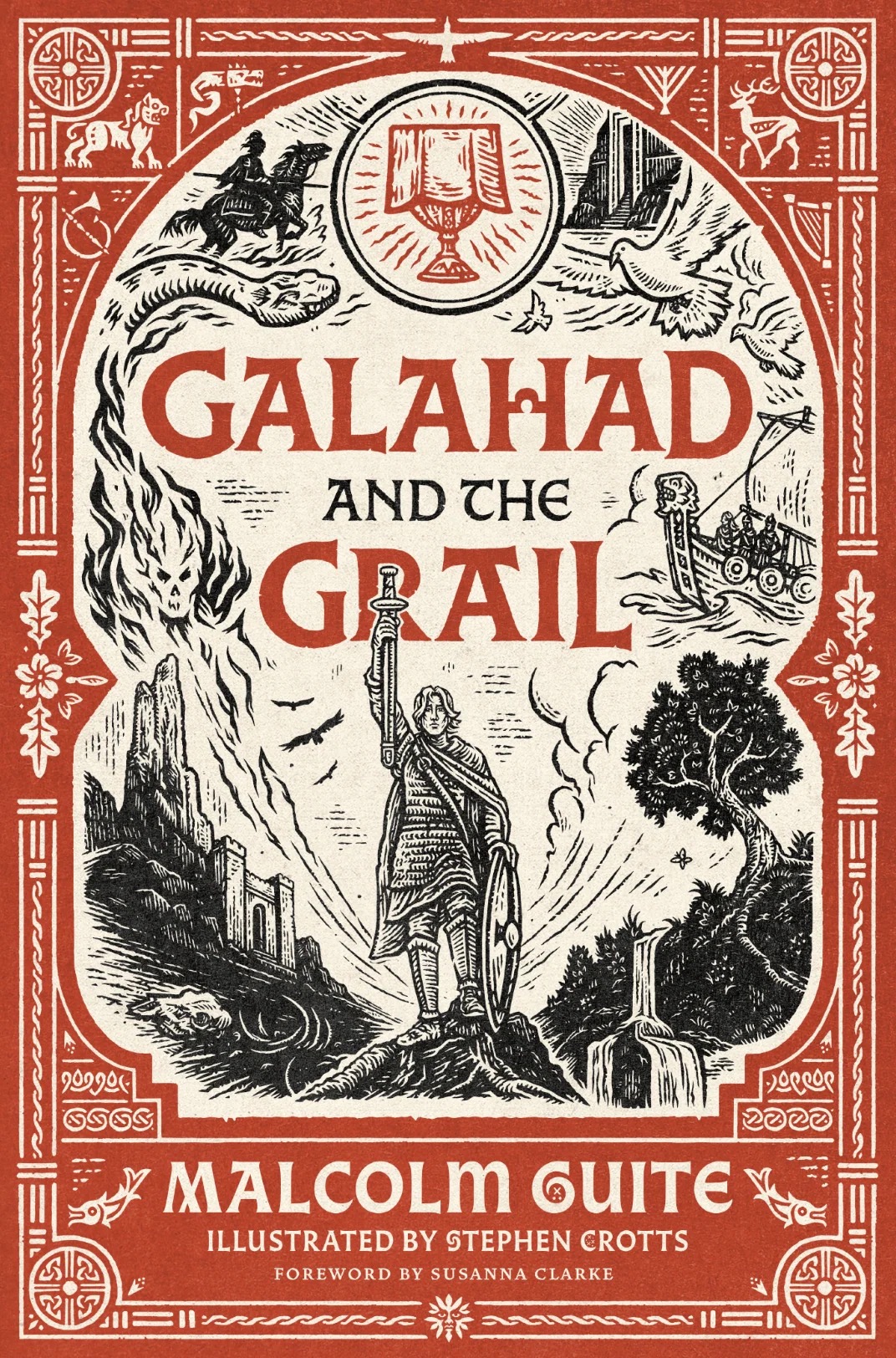
Book Review: Galahad and the Grail
Malcolm Guite, Galahad and the Grail in Merlin’s Isle: An Arthuriad, 1. Illustrated by
Stephen Crotts. Nashville: Rabbit Room Press; April 20, 2026. 372 pages. ISBN
1951872703.
This year saw the publication of a new imaginative work brushing the dust off an ancient tale. Malcolm Guite’s Galahad and the Grail is the first installment in a four-volume series, Merlin’s Isle: An Arthuriad, published by Rabbit Room Press and illustrated by Stephen Crotts.
With its arrival comes the recurring conundrum ~ how do we as readers of the great works of old justify not only reading, but reveling in, a contemporary text? Like other story-loving parents, I am always looking for the next great work to put into the hands of my children. Usually, that means pulling a “tried and true” favorite off the shelf.
But when Galahad and the Grail arrived at our door, we had the sense that contained within its pages was a classic-in-the-making. Being of the somewhat adventurous sort, we borrowed Augustine’s famous dictum, tolle lege . . . and here is what we discovered.
First, and not insignificantly, this book is beautiful. Great care has been taken to ensure that every aspect of the book, from the symbolic richness of its dust jacket, through the colors of and on the pages, to the images illuminating and gracing the text, supports the pulse of Guite’s poem – the desire for restoration and redemption. As Susanna Clarke reminds us in her foreward, “the quest for the Grail is a journey into Christian mysticism” (xiv).
If Guite’s vision gives this poem its power, his words give it voice. From its opening stave, this poem sings. In what Guite himself describes as “the ringing, singing, rhythmic form of the English ballad,” the stories of Arthur and his knights bob and weave, creating a pattern as intricate and complicated as the vices and virtues they encounter. Consider the introduction of the young Galahad:
The young child saw those wasted lands;
he longed to set things right.
He prayed that Christ might one day send
some messenger to care and tend,
to heal where others tear and rend,
and turn the darkness bright. (I.1.35-40)
In this moment, Guite crafts one boy’s longing to repair the broken world in words and rhythms simple, and yet powerful, enough to stir every heart. What better gift to offer our listening children?
Finally, it is worth nothing that while Guite is not the first poet to take up Arthur’s tale (Guiteacknowledges his indebtedness to many predecessors), his story of the Arthur legend and its constellation of tales is not simply a modern retelling. It is, in fact, born of a desire to honor the stories as they were originally imagined ~ an ancient retelling, as it were. In an explanation of his project, Guite sorrows over the ways in which “so many modern versions of [the Arthuriad] seemed to marginalize or even erase the deep Christian impulse that had formed their original telling” (315). Galahad and the Grail is Guite’s attempt to recapture the true magic of those earlier versions.
Perhaps this is what Guite ultimately offers us, the chance to remember a time when “hermits, ladies, knights, and king . . . . take it for granted that the most splendid thing they [and we] can do is to try to live our lives according to an impossible ideal, whether you call that ideal chivalry or an imitation of Christ” (Clarke xiv). And in so doing, Malcolm Guite gives us a work that will last beyond our own reading. What could be more classic than that?


