
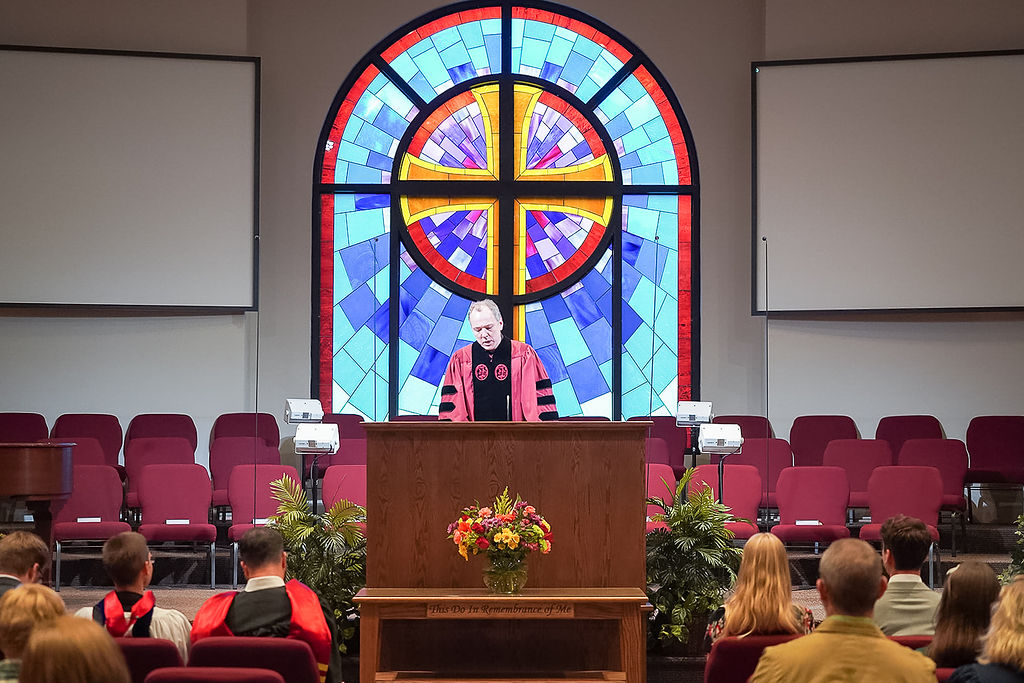
President Smith’s Remarks on the Occasion of New Aberdeen’s First Convocation
When I was in graduate school, I strolled through our church’s cemetery each Sunday before worship. I reveled in the tangible connection to previous generations of believers.
But one plot haunted me.
Rev. Joseph Wilson was a staunch nineteenth-century Southern Presbyterian minister who preached at First Presbyterian Church in Columbia. His son, Woodrow, spent his teenage years in the same church in which I now worshiped. Before he became President of the United States, Woodrow Wilson devoted his career to academics, later ascending to the helm of Princeton University.
Wilson once wrote in his diary that he was “unorthodox in his religion,” and indeed, he abandoned his father’s covenant theology and embraced theological liberalism. According to one commentator, “[Wilson] believed that Christian presuppositions and supernaturalism needed to be removed from the intellectual work of the school. That is, academic excellence trumped doctrine.”[1] Sadly, President Wilson led Princeton further away from its theological moorings and became one of the nation’s most progressive presidents.
It was this change that haunted me about the Wilson family grave. Why did someone from my faithful, conservative congregation abandon his teaching so radically? Does Christ really have no place in the Academy? Is the bifurcation between faith and scholarship inevitable?
College is Dangerous
As I soon learned, Wilson’s spiritual trajectory typifies the American pattern of higher education. Since the rise of modern liberalism in the late nineteenth-century Academy, colleges have divorced young men and women from their evangelical faith with relative ease. Some adopt views that conflict with their church’s teachings. Others leave the faith altogether. Current studies show that nearly 70% of Christians leave their faith in college. The enemies of the gospel understand that the four years from 18 to 22 often have a greater impact on one’s life than the previous 18 years. Thus, higher education is the bottleneck into apostasy.
New Aberdeen College was born out of a desire to create an institution that is confessionally grounded, intellectually rigorous, and communally oriented. What’s more, our model is shockingly unoriginal – it’s based on the proven liberal arts and humanities tradition that dominated the English-speaking world until the German institutions of the Enlightenment disrupted the model.
But today, the space for colleges is noisy and complicated. The obstacles for this type of project are myriad. Parents expect sprawling campuses, cafeterias, sports teams, dormitories, fraternities and sororities, accreditation by the bureaucrats, placement services, and a plethora of majors and minors. New Aberdeen offers none of those.
Basis: Liberality
What makes New Aberdeen unique is our recovery of the ancient idea of liberality. The liberal arts free men from servile tutelage, enabling them to pursue a variety of both vocations and avocations. Despite what culture tells us, it is we who are the true liberals.
Unlike modern education’s obsession with trendiness, classical education seeks to mine the wealth of great thinkers from the preceding millennia. We are pursuing a classical mode of education because it cultivates truth, goodness, and beauty. The Socratic question-based approach to teaching requires conversation, which is a method of learning that mimics Christ’s teaching recorded in the Gospels while facilitating deeper learning and a more closely knit academic community.
A beautiful example of classical education’s impact can be found in Alexander Dumas’ novel, The Count of Monte Christo. In this story, a young sailor named Dantes is wrongfully sentenced to jail, but providentially imprisoned next to a priest who possesses an enviable education.
Dumas spends two chapters chronicling their relationship. This exchange is particularly compelling:
“Alas, my boy,” said [the priest], “human knowledge is confined within very narrow limits; and when I have taught you mathematics, physics, history, and the three or four modern languages with which I am acquainted, you will know as much as I do myself. Now, it will scarcely require two years for me to communicate to you the stock of learning I possess.”
“Two years!” exclaimed Dantès; “do you really believe I can acquire all these things in so short a time?”
“Not their application, certainly, but their principles you may; to learn is not to know; there are the learners and the learned. Memory makes the one, philosophy the other.”
You see, the priest’s educational impact on this young, uneducated sailor was transformative. Dumas remarks, “At the end of a year Dantès was a new man.”
The Foundation: Faith
The fact that a priest educated Dantes reminds us that education cannot be separated from faith. A classical education in pursuit of wisdom and virtue cannot succeed without Christ. The Proverbs remind us, “The fear of the Lord is the beginning of wisdom.” That is why New Aberdeen is a Christian college: we believe that a biblical worldview must frame each of our disciplines.
Herman Bavinck aptly remarked, “Any science, philosophy, or knowledge which supposes that it can stand on its own pretensions, and can leave God out of its assumptions, becomes its own opposite, and disillusions everyone who builds his expectations on it.”
Bavinck’s position starkly contrasts with President Wilson’s. Removing Christian assumptions from the Academy, as Wilson did, was rarely done in the great medieval universities. That kind of thinking amounts to Deism – the idea that Christ is not involved his creation, and much less, each academic discipline.
Sadly, the Church is rarely troubled by this cultural pattern. But our college affirms the necessity of pervasive Christian thought in higher education, that science and religion have a meaningful relationship, that the philosophies of the Ancient Greeks are relevant to today’s students, that music has bearing on the morality. These ideas are transformative.
One final word about our identity is in order. New Aberdeen is a confessionally Christian college. While most evangelicals claim to believe that Bible is God’s word, the range of interpretation varies dramatically. Confessions articulate how we understand the Scriptures and protect us from individualism and heresy. As my Lutheran contemporary Dr. Christian Preus states, “A college not anchored to a specific theological confession will in time have no confession at all.”
Have you noticed how denominational schools that are not committed to their confessions always drift into spiritual oblivion? Our confessions anchor us to a thoughtful theological tradition, provide accountability to our family of churches, and chart a trustworthy intellectual course for the future. Confessions matter.
A Final Example to Follow
Many are you are familiar with Abraham Kuyper’s famous quip, “There is not a square inch in the whole domain of our human existence over which Christ, who is Sovereign over all, does not cry, Mine!” You may not know the context for this quote. Kuyper understood the need for a distinctly Christian education in the Netherlands, and his “square inch” statement appears in his 1880 dedicatory speech for a new college.
A few words later, he declared,
“And so, without blushing or shyness, our small school begins its life with the name ‘university.’ Poor in money, very frugally endowed with intellectual power and content with the favor of a people without honor. And what then will now be its course? How long will it live? O, the dozens of questions that arise regarding the future! They cannot more strongly battle in your doubting thoughts than they have stormed this heart! Only by again and again focusing on our holy principle, after each crash of waves which beats over us, did our weary head raise itself courageously again from the water. Surely if this enterprise did not depend on the of the Mighty One of Jacob, how would it be able to stand. For I do not exaggerate, what we are venturing in the establishment of this School runs contrary to all that is called great, counter to a world of scholars, counter to an entire century, a century of great charm.”
New Aberdeen’s opening tonight is hardly any different. But, like Kuyper, we also understand that we serve a Triune God who is worthy of this sacrifice, and on whose strength we depend entirely. We refuse to surrender the battle to indoctrinate our young men and women in such a way that dishonors the Lord.
So you see, the contrast between Woodrow Wilson and Abraham Kuyper cannot be more stark. Both knew their Scriptures. Both knew the Westminster Confession. Both knew Calvin’s Institutes. Both devoted themselves to lives of service in the church, politics, and education. But when they entered the Academy, only one chose the glory of God over the glory of man.
As long as New Aberdeen College stands, let us pursue our glorious Savior as we seek form mature disciples in the traditions of classical learning and the Reformed faith.